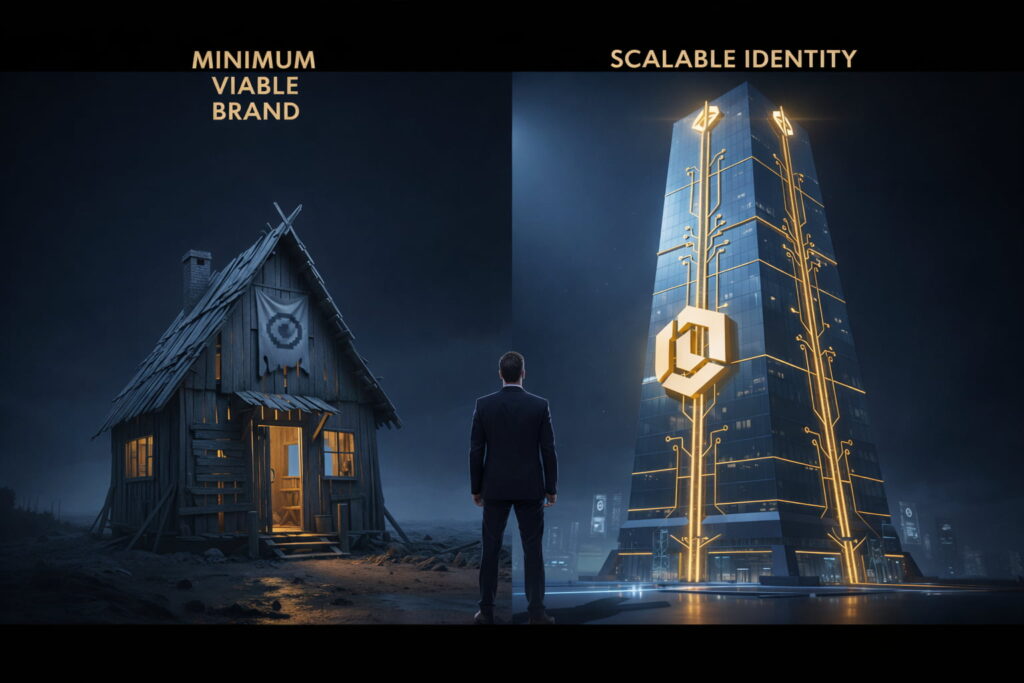
In the 2026 business ecosystem, the “Lean Startup” methodology has been dangerously misinterpreted. Founders have become obsessed with the MVP (Minimum Viable Product), while the visual and strategic identity has been demoted to a “post-launch ornament.” This strategic blunder has birthed a phenomenon that kills more businesses than bad code: the Minimum Viable Brand (MVB)—a brand that cannot sustain the weight of its own success.
The economic reality is brutal: you never get a second chance to make a first impression. Whether you are pitching to a Venture Capitalist or a Tier-1 Enterprise client, your brand is the “silent closer.” If your startup promises to revolutionize Cybersecurity but your website looks like a 2019 template, you have already lost the battle of trust. This article dissects why startups fail due to restrictive branding and how a Scalable Identity engineered by Designx serves as a company’s most powerful financial asset.
Defining the Minimum Viable Brand (MVB)
A Minimum Viable Brand is, by definition, a temporary fix. It is the “fast-food” version of design. It’s the logo made in ten minutes on a cheap generator, the color palette chosen at random because the founder “liked blue,” and a total lack of a cohesive communication strategy.
While an MVB may suffice for the “Friends and Family” seed round where investors are betting on the individual, it quickly becomes a “Glass Ceiling” once you enter the open market.
The Stagnation Tax of MVB
Startups that remain trapped in an MVB pay an invisible tax every day:
- Lack of Differentiation: In a market saturated with AI-as-a-Service, a generic brand is invisible. If you look like everyone else, you are forced to compete on price, which is a race to the bottom.
- Technical Inconsistency: An MVB isn’t built for scale. The logo “breaks” when resized for a mobile favicon or a trade show billboard. The colors look different on a MacBook screen than they do on a printed business card.
- High Rebranding Debt: Changing your identity six months post-launch—after you’ve gained minor traction—costs 10x more in “recognition loss” than doing it right the first time.
Visual Technical Debt: The Cost of Cheap Design
In the economic profile of a startup, we often talk about “Technical Debt”—the cost of choosing an easy, low-quality code solution now instead of a better approach that would take longer. Branding has the exact same dynamic.
When you launch with an amateur identity, you are taking out a “Visual Loan.” This loan gathers interest in the form of lost leads, missed partnerships, and a lower perceived value. Eventually, the debt becomes so high that the business stalls. You cannot sell a €50,000/year Cybersecurity contract with a brand that looks like it cost €50.
The Scalable Identity: Architecture for the Future
Unlike an MVB, a Scalable Identity is built on Business Intelligence. It isn’t just about aesthetics; it’s about a visual system that adapts as the company grows from 1 to 100 employees and from zero to €10 million in revenue. At Designx, we view branding as a living organism.
The Pillars of a Scalable Identity:
- Modularity: The brand must allow for expansion into new product lines without losing its core “DNA.” If your startup pivots from “AI for Accounting” to “AI for Logistics,” your brand system should be robust enough to handle the shift.
- Systems over Symbols: A scalable identity provides a full Design System (typography, grids, icon styles, motion rules). It ensures that your mobile app feels exactly like your web dashboard and your LinkedIn ads.
- Psychological Resonance: The brand is built on archetypes that resonate with the target audience at a subconscious level. It targets the “Limbic System” of the brain, ensuring long-term loyalty before a single feature is used.
Reasons Why Startups Fail the “First Impression” Test
According to economic studies on digital behavior, a user takes 0.05 seconds (50 milliseconds) to form an opinion about a brand. Startups fail this test for three specific reasons: (https://www.nngroup.com/articles/first-impressions-human-automaticity/)
1. The “Amateur Gap”
When founders DIY their branding, they create an “Amateur Gap.” The visitor feels the lack of professionalism instantly. In high-stakes industries, design flaws signal a lack of attention to detail in the product itself.
2. Copycat Syndrome
Many startups try to look “like Apple” or “like Stripe.” The result? You become a pale reflection of someone else’s success. A Scalable Identity gives you your own visual language, forcing the market to recognize you as a leader, not a follower.
3. The Identity-Product Gap
This occurs when the marketing says one thing, but the product UX says another. If your website is sleek and modern, but your app interface is clunky and dated, the “Trust Gap” widens. A Scalable Identity ensures that the brand promise is delivered at every touchpoint.
The Financial Multiplier: Branding as a Valuation Asset
At Designx, we treat branding through the lens of ROI (Return on Investment). For a startup looking for an exit or a Series A, a solid identity increases company valuation.
- Investor Confidence: A pitch deck that is perfectly branded suggests operational rigor and a founder who understands the importance of market positioning.
- LTV (Lifetime Value) Increase: Customers stay loyal to brands that provide a premium aesthetic experience. A well-branded company can charge 20-30% more for the same service than a non-branded competitor.
- Talent Acquisition: Top-tier engineers and designers want to work for “cool” brands. A Scalable Identity helps you recruit the best talent for less money because the “status” of working for the company is a benefit in itself.
The 12-Month Brand Scaling Roadmap
For the economic-profile startup, we suggest a phased approach to branding that aligns with funding rounds:
Phase 1: The Foundation (Pre-Seed)
Focus on core values and a “Clean” primary identity. No complex animations—just a solid logo, a primary font, and a distinct color palette.
Phase 2: The Design System (Seed)
As you build the product, build the Design System. Document how the brand lives in the UI. Create templates for social media and sales decks.
Phase 3: The Authority Expansion (Series A)
This is where you invest in high-end Motion Design, 3D assets (Designx specialty), and a custom-coded website that pushes the boundaries of the industry.
Branding for the AI Generation: 2026 and Beyond
In 2026, brands are no longer static images on a screen. They must live in dynamic, AI-driven environments. A startup’s identity must be optimized for:
- Adaptive Interfaces: Brand elements that change based on the user’s focus.
- Haptic Identity: How the brand “feels” in a spatial computing environment (Apple Vision Pro, etc.).
- AI-First Social Media: Content that is engineered for algorithmic virality while maintaining 100% brand consistency.
Conclusion: Build for What You Want to Become
The startups that dominate the market aren’t just those with the best code; they are those with the best visual story. Moving from a Minimum Viable Brand to a Scalable Identity is the step that transforms a garage project into a global entity.
An MVB says: “We are trying to be a company.” A Scalable Identity says: “We are the industry standard.”
Don’t leave your first impression to chance. Invest in authority, invest in scalability, and invest in the economic future of your company.
Are you ready to turn your startup into an unstoppable visual force? Book a Strategy Session with Designx. Let’s build the identity that will support your first million.